

Why FTA registration is your first compliance obligation
The UAE Federal Tax Authority (FTA) is the government body responsible for administering and collecting federal taxes across the Emirates. Every business operating in the UAE — mainland, free zone, or offshore with a permanent establishment — must register with the FTA before it can lawfully conduct taxable activities. That means obtaining a Tax Registration Number (TRN) for corporate tax, VAT, excise, or all three, depending on your business activities and revenue thresholds.
The introduction of UAE corporate tax under Federal Decree-Law No. 47 of 2022 (effective for financial years starting on or after 1 June 2023) created a new layer of mandatory registration for virtually all UAE-resident juridical persons. Added to the existing VAT registration obligation under FDL No. 8 of 2017, many businesses now face two distinct registration requirements — each with its own portal workflow, documentation checklist, and deadline.
Missing a registration deadline is costly: AED 10,000 for late CT registration, AED 20,000 for late VAT registration — applied immediately upon FTA assessment with no grace period. My role is to ensure you register correctly the first time, on time, with all entity classifications and tax period elections set up to minimise your long-term compliance burden.
What is the UAE Federal Tax Authority?
The FTA was established by Federal Law No. 13 of 2016 as the UAE government body mandated to manage and supervise the administration of federal taxes and their related procedures. It is responsible for:
- Registering all taxable persons for corporate tax, VAT, and excise tax
- Issuing and updating Tax Registration Numbers (TRNs)
- Receiving tax returns and processing tax payments via the EmaraTax portal
- Conducting tax audits, inspections, and issuing tax assessments
- Enforcing compliance through administrative penalties
- Processing voluntary disclosures, objections, and reconsideration requests
All FTA interactions — registration, return filing, payment, voluntary disclosure — are conducted through the EmaraTax portal at tax.gov.ae. UAE Pass integration allows authorised signatories to authenticate directly, but the system's complexity means errors in entity classification or document submission frequently lead to application rejections and delays.
UAE corporate tax registration — who must register?
Under Article 51 of Federal Decree-Law No. 47 of 2022, the following persons are required to register for corporate tax with the FTA:
| Entity Type | Registration Requirement | Key Note |
|---|---|---|
| UAE mainland company (LLC, branch, etc.) | Mandatory | All entities, regardless of profit or loss |
| UAE free zone entity | Mandatory | Including Qualifying Free Zone Persons (QFZPs) |
| Foreign company with UAE PE | Mandatory | Based on permanent establishment test |
| Natural person (individual) in business | Mandatory if revenue > AED 1M | Business income from UAE or foreign sources |
| Government entities | Exempt — registration not required | Cabinet Decision No. 49 of 2023 |
| Qualifying Investment Funds | Conditional exemption applies | Must still register and meet conditions |
Entities that are exempt from corporate tax — such as government entities and certain non-profit organisations — may still be required to register and notify the FTA of their exempt status. Failure to do so triggers the same late-registration penalties.
CT registration deadlines & late penalties
Cabinet Decision No. 75 of 2023 established a staged registration timeline based on the month in which the entity's trade licence was issued. Entities must register within the prescribed period from their licence issuance date — regardless of when their first taxable period begins.
AED 10,000
Late CT Registration
Fixed penalty — applied immediately upon FTA assessment (CD No. 75 of 2023)
AED 20,000
Late VAT Registration
Fixed penalty for failure to register when turnover exceeds AED 375,000 threshold
14% p.a.
Late Payment Interest
On outstanding tax from due date (Cabinet Decision No. 129 of 2025)
Already past your deadline?
Register immediately — the AED 10,000 penalty is fixed regardless of how late you register. Delaying further only exposes you to additional FTA scrutiny. I can help you register today and, where appropriate, submit a reconsideration request to the FTA to mitigate penalties.
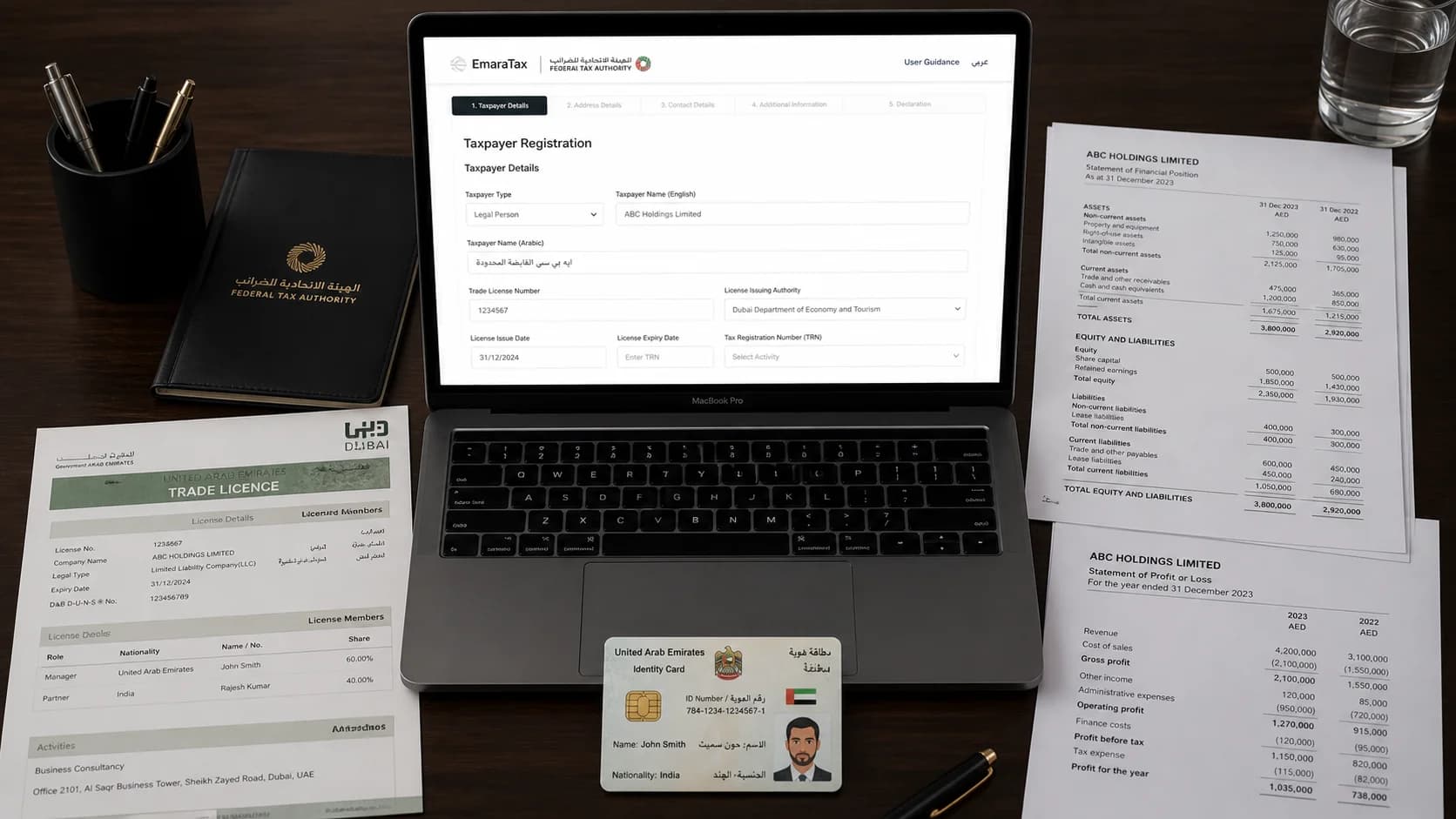
Step-by-step: CT registration on EmaraTax
The corporate tax registration process is completed entirely online through the EmaraTax portal. While the steps appear straightforward, errors in entity classification, tax period selection, or document formatting are common causes of application rejection.
Determine registration obligation
Confirm whether your entity is a Resident or Non-Resident Person under FDL No. 47 of 2022 and identify your first taxable period start date.
Create your EmaraTax account
Register on the FTA EmaraTax portal (tax.gov.ae) using UAE Pass or corporate email. Set up the entity profile and authorise the signatory.
Complete the CT registration form
Enter entity details, select the correct financial year, and classify your entity type (LLC, free zone QFZP, branch, individual, etc.).
Upload supporting documents
Submit: valid UAE trade licence, Memorandum of Association, Emirates ID and passport of authorised signatory, and ownership structure details.
Receive CT TRN
The FTA issues a 15-digit Tax Registration Number within 3–5 business days of a complete and accurate application.
CT return filing & tax period management
Registration is just the beginning. Once registered, you must file a CT return for each tax period — typically aligned to your financial year — within nine months of the end of that period. For a company with a December year-end, this means filing by 30 September of the following year.
The CT return requires preparation of financial statements aligned to the accounting standards specified in FDL No. 47 of 2022, adjustments for non-deductible expenses, exempt income, and transfer pricing, and calculation of the taxable income at the applicable rate:
0%
Taxable income up to AED 375,000
9%
Taxable income above AED 375,000
0%
Qualifying Free Zone Person (QFZP) on qualifying income
Small Business Relief under Cabinet Decision No. 73 of 2023 allows businesses with revenue not exceeding AED 3 million to elect to treat their taxable income as nil for tax periods ending on or before 31 December 2026 — but the election must be claimed on the CT return; it is not automatic.

CT tax groups — consolidating related entities
Under Article 40 of Federal Decree-Law No. 47 of 2022, two or more UAE resident juridical persons may form a Tax Group if one entity holds at least 95% of the shares or voting rights of the other(s), directly or indirectly. Tax Group members are treated as a single taxable person:
- The parent company files a single consolidated CT return covering all group members
- Intra-group transactions are eliminated for CT purposes — no transfer pricing obligations between members
- Losses of one group member offset profits of another within the same tax period
- All group members must share the same financial year and accounting standards
- Free zone entities with QFZP status cannot join a mainland Tax Group
VAT grouping under FDL No. 8 of 2017 operates on a lower ownership threshold (50% or more) and follows different rules — a CT Tax Group and a VAT Group for the same entities are two separate applications. I manage both, ensuring the group structure is correctly reflected on the EmaraTax portal.
Corporate tax deregistration
Businesses that cease to be subject to corporate tax — through cessation of activities, company liquidation, or change in legal status — must apply to deregister from CT with the FTA. Deregistration requires:
- Filing all outstanding CT returns up to the deregistration date
- Settling all outstanding CT liabilities and penalties
- Submitting evidence of business cessation (liquidation certificate, trade licence cancellation, etc.)
- Receiving FTA confirmation of deregistration — the TRN is cancelled only upon FTA approval
Continuing to hold an active TRN after business cessation without filing returns triggers non-filing penalties. Deregistering correctly and on time closes your compliance obligations cleanly. For companies going through formal liquidation, see our Company Liquidation UAE service.
UAE VAT registration via the FTA
Value Added Tax at 5% was introduced in the UAE on 1 January 2018 under Federal Decree-Law No. 8 of 2017. Registration for VAT is separate from corporate tax registration — it uses a different TRN and a different set of obligations.
Mandatory VAT Registration
Threshold: Taxable supplies > AED 375,000 p.a.
Late registration: AED 20,000 for late registration
Voluntary VAT Registration
Threshold: Taxable supplies between AED 187,500 – AED 375,000
Late registration: No penalty for voluntary registration
VAT registration also involves selecting the correct registration category, determining the effective date, and ensuring your invoicing and accounting systems are set up to issue compliant tax invoices. For a full treatment of VAT obligations — returns, input tax recovery, and sector-specific rules — see our dedicated VAT Registration & Advisory page.
UAE excise tax registration
Excise tax was introduced on 1 October 2017 under Federal Decree-Law No. 7 of 2017. It is a single-stage consumption tax levied on specific goods deemed harmful to health or the environment. Businesses must register for excise tax before they commence any excise-taxable activity.
| Excise Good | Rate | Who Must Register |
|---|---|---|
| Tobacco products (cigarettes, shisha, etc.) | 100% | Importers, manufacturers, warehouse keepers |
| Energy drinks | 100% | Importers, manufacturers, warehouse keepers |
| Carbonated / sweetened beverages | 50% | Importers, manufacturers, warehouse keepers |
| Electronic cigarettes / vaping devices | 100% | Importers, manufacturers |
| Liquids used in electronic cigarettes | 100% | Importers, manufacturers |
FTA inspection & audit rights
The FTA has broad inspection and audit powers under Federal Law No. 7 of 2017. Tax auditors may visit business premises, request access to accounting records, financial systems, and supporting documentation, and conduct interviews with employees and management. Inspections can be pre-announced or unannounced.
Your rights during an FTA inspection
- 24-hour advance notice required (except in urgent cases)
- Right to request inspection postponement (up to 5 business days)
- Right to be present during the inspection
- Right to receive a copy of the inspection notice
Your obligations during an FTA inspection
- Provide access to all requested records and systems
- Make relevant employees and management available
- Maintain records in accessible format (FTA can access digital systems)
- Respond to FTA information requests within prescribed timelines
Tax assessment, voluntary disclosure & objection
If the FTA believes a taxable person has underpaid tax, it may issue a tax assessment determining the tax due. Separately, a taxable person who discovers an error in a previously filed tax return must submit a Voluntary Disclosure on the EmaraTax portal — this proactively corrects the error and typically attracts lower penalties than waiting for an FTA assessment.
Voluntary Disclosure
Filed by the taxpayer to correct errors in prior returns. Penalties apply but are lower than post-assessment penalties. Must be filed before the FTA initiates an audit.
Tax Assessment
Issued by the FTA after an audit or inspection. The taxpayer has 40 business days to pay or object.
Reconsideration Request
Submitted to the FTA within 40 business days of an administrative penalty decision. The FTA has 40 business days to respond.
Objection to TDRC
If the reconsideration is rejected, the taxpayer may file an objection with the Tax Disputes Resolution Committee (TDRC) within 40 business days.
Tax implication report
Before registering a new entity, expanding into a new activity, or restructuring an existing business, a Tax Implication Report assesses the full scope of your FTA registration obligations:
- Which taxes apply — CT, VAT, excise, or a combination
- Whether mandatory or voluntary registration thresholds are met
- Optimal tax period selection and financial year alignment
- Free zone QFZP eligibility assessment and conditions
- Tax group eligibility for multi-entity structures
- Transfer pricing obligations where related-party transactions exist
FTA registration & compliance services
I manage the full lifecycle of your FTA registration — from initial application to ongoing compliance, amendments, and deregistration.
Corporate Tax Registration
Entity classification, tax period selection, EmaraTax account setup, and CT TRN issuance under FDL No. 47 of 2022.
VAT Registration & Advisory
Mandatory and voluntary VAT registration with correct effective date determination and category assessment under FDL No. 8 of 2017.
Excise Tax Registration
Registration for importers, manufacturers, and stockpilers of tobacco, energy drinks, carbonated drinks, and other excise goods.
Tax Group Formation
Structuring and registering CT and VAT groups for related entities — single return filing, consolidated compliance.
Voluntary Disclosure & Objection
Correcting prior period errors via voluntary disclosure and managing FTA assessments and objection procedures.
CT & VAT Deregistration
Managed deregistration from corporate tax or VAT following business cessation, sale, or change of taxable activity.

Frequently asked questions
Who must register for corporate tax in the UAE?
What is the deadline to register for UAE corporate tax?
What is the penalty for late FTA corporate tax registration?
What documents are required for FTA CT registration?
Can related UAE companies form a CT tax group?
How long must corporate tax records be retained?
Register correctly before your deadline
Late CT registration carries an immediate AED 10,000 penalty — with no grace period and no ability to appeal the amount. I manage the full EmaraTax registration process: entity classification, tax period election, document preparation, portal submission, and TRN receipt. One fixed fee. No surprises.

Written & reviewed by
Jashvantkumar Prajapati
Founder & CEO, Avyanco Group
21+ years advising founders and investors on UAE company formation, tax structuring, and cross-border expansion. CSP Licensed by the Dubai Economic Department. Direct experience helping 11,000+ businesses across mainland, free zone, and offshore structures.