

Most UAE business owners received their first FTA corporate tax notice in 2023 and had no idea what to do next. The notices were brief. The obligations were not.
UAE Corporate Tax at 9% applies to taxable income above AED 375,000 for financial years starting on or after 1 June 2023. Every UAE business — including those that will pay 0% — must register with the FTA and file an annual CT return. There is no exemption from registration, and there is no grace period for businesses that missed the deadline.
Since the law came into force, I have guided hundreds of UAE businesses through CT registration, structure reviews, free zone eligibility assessments, and ongoing annual filing. That includes mainland LLCs, JAFZA entities, DMCC companies, holding structures, and sole establishments. The problems I see are consistent. Most of them were preventable.
Not sure whether your business is CT-registered correctly? I'll review your registration status and flag any compliance gaps at no cost.
Book a free 30-minute callWhat is UAE Corporate Tax?
UAE Corporate Tax was introduced under Federal Decree-Law No. 47 of 2022. It applies to financial years starting on or after 1 June 2023. For businesses running a calendar accounting year, the first CT financial year began 1 January 2024.
The rate structure is straightforward: 0% on taxable income up to AED 375,000, and 9% on taxable income above that threshold. These rates apply to all UAE-resident taxable persons unless a specific exemption or relief applies.
Small Business Relief is available under Cabinet Decision No. 116 of 2022. If your revenue does not exceed AED 3 million in a tax period — and did not exceed AED 3 million in any prior period since 1 June 2023 — you can elect for your taxable income to be treated as zero. The election must be made in your CT return. It is not automatic, and it does not remove your obligation to register and file. This relief is available for tax periods ending on or before 31 December 2026 only.
Free zone businesses may qualify for a 0% rate on qualifying income as a Qualifying Free Zone Person. The conditions for that status are specific and require active assessment — they are not granted by virtue of incorporation in a free zone. Regardless of 0% eligibility, every free zone company must register with the FTA and submit an annual CT return. For a broader view, see the full tax advisory overview.
Who Must Register for Corporate Tax in UAE?
The registration obligation is broad. It applies to:
- All UAE mainland companies — LLCs, sole establishments, civil companies, branches of foreign companies, and other incorporated entities
- All UAE free zone companies — including those incorporated in DIFC, ADGM, JAFZA, DMCC, and every other designated free zone
- Foreign companies with a permanent establishment in the UAE — through a branch, agent, or any fixed place of business
- Individuals earning UAE-sourced business income above AED 1 million per year — self-employed persons and sole traders operating under a trade licence
- Natural persons conducting business activity in the UAE where that activity generates income above the applicable threshold
One category explicitly outside scope: employees receiving salary income are not subject to UAE Corporate Tax. Payroll income paid under an employment contract is not a business activity for CT purposes.
How Jashvant Handles Corporate Tax — From Registration to Filing
CT compliance is not a single event. It requires structured setup, quarterly monitoring, and annual filing within strict FTA deadlines.
Business Structure Review
Week 1I review your legal structure, entity type, free zone status, and current financial year dates. I assess whether your business derives qualifying income, whether QFZP conditions are likely to apply, and whether you have any related-party transactions that require transfer pricing analysis. This step determines every subsequent decision.
FTA Registration via EmaraTax
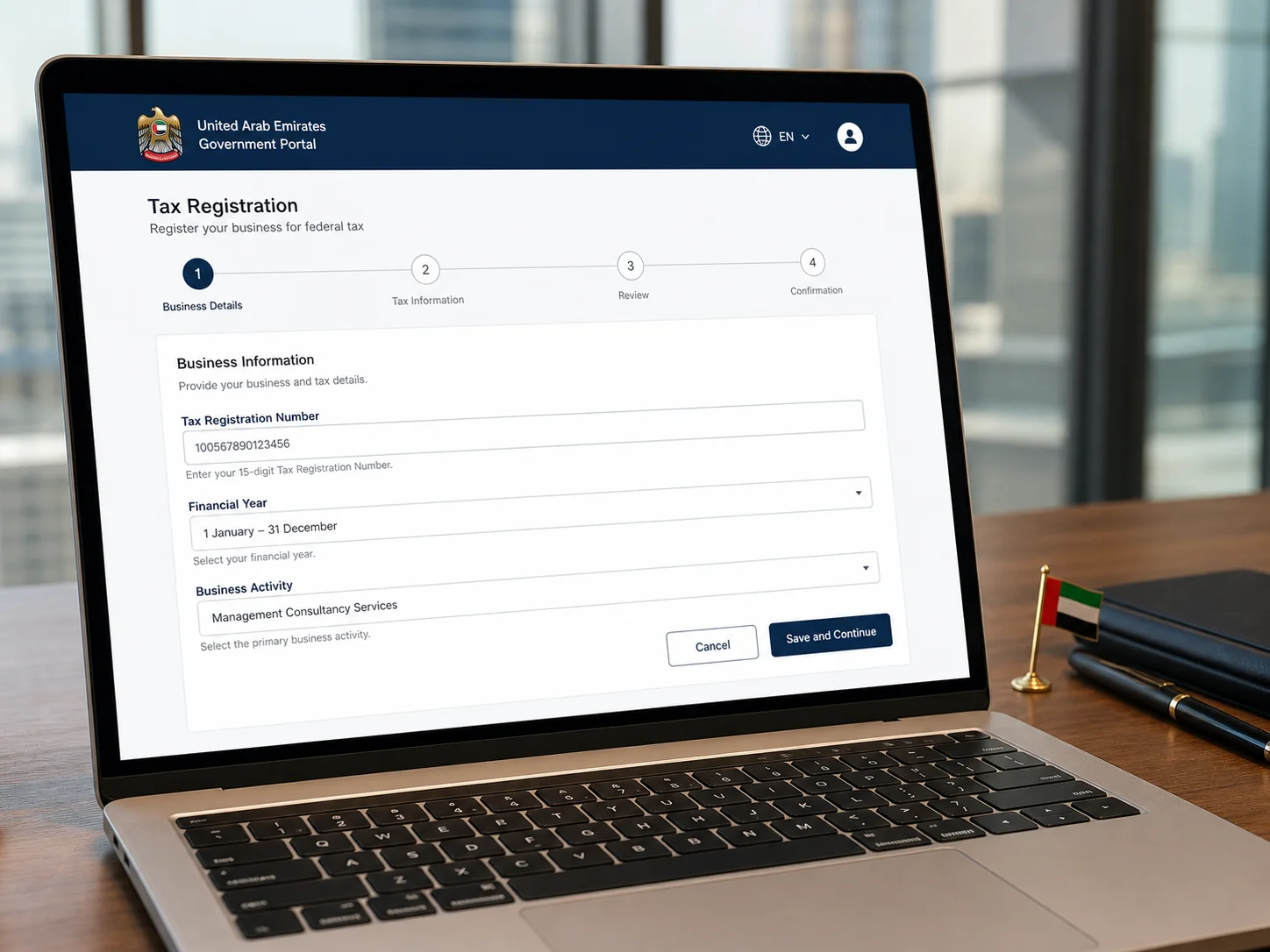
Week 1–2I register your business on the FTA EmaraTax portal, obtain your Corporate Tax Registration Number (TRN), and confirm the correct effective registration date. Your CT TRN is separate from your VAT TRN — even if you are already registered for VAT compliance, a separate CT registration is required.
Financial Year Alignment
Week 2I confirm that your CT financial year aligns with your accounting year. I review your chart of accounts to ensure it separates qualifying income, non-qualifying income, exempt income, and allowable deductions in a way that supports accurate CT filing. Reviewing opening balances at this stage prevents errors from carrying forward into the first return.
Transfer Pricing Assessment
Week 2–3 (if applicable)If your business has transactions with related parties — group companies, parent entities, subsidiaries, director loans, or management fee arrangements — I review those transactions against the arm's-length standard. I determine whether a Master File, Local File, or Disclosure Form is required, and I prepare the necessary transfer pricing documentation before FTA scrutiny arises.
Provisional Tax Monitoring
Ongoing — quarterlyI track your taxable income position quarterly. This allows me to flag any changes in Small Business Relief eligibility, identify deductible expenditure that should be captured, and ensure that your year-end position does not produce surprises. CT is filed annually, but the position is built throughout the year.
Annual CT Return Filing
Within 9 months of FY endI prepare and file your annual corporate tax return through EmaraTax. This includes reconciling accounting profit to taxable income, applying applicable exemptions and reliefs, calculating the final tax liability, and managing any payment due. I also review the return against prior-year positions to ensure consistency.
Ongoing Advisory
Annual+Tax law changes. FTA issues new public clarifications. Cabinet Decisions are updated. I provide ongoing advisory support — annual position reviews, FTA query management, and voluntary disclosure support where prior-year errors need to be corrected before they attract penalties.
Key Benefits of Structured Corporate Tax Advisory
Avoidance of AED 10,000–50,000 in penalties for late registration, late filing, and record-keeping failures — all actively enforced by the FTA
Correct identification of qualifying free zone income eligible for the 0% CT rate versus non-qualifying income taxable at 9% — the difference on AED 1 million of income is AED 90,000
Small Business Relief assessment for businesses with revenue under AED 3 million — correctly elected, this eliminates your CT liability entirely for that period
Transfer pricing documentation that protects your business against FTA audit adjustments on related-party transactions — prepared contemporaneously, not retrospectively
Year-round tax position management that produces an accurate, defensible CT return — not a last-minute filing scramble based on incomplete records
Common Mistakes UAE Businesses Make with Corporate Tax
Assuming free zone means automatic 0% CT
Being incorporated in a UAE free zone does not make you a Qualifying Free Zone Person. QFZP status requires adequate economic substance, qualifying income streams, transfer pricing compliance, and no election to be treated under standard CT. Most free zone businesses are surprised to learn that their mainland UAE trading income is fully taxable at 9% regardless of where they are registered.
Missing the registration deadline
The FTA has issued AED 10,000 administrative penalties for late CT registration, and these are being enforced. The registration deadline is calculated from the start of your first CT financial year — not from when you first received an FTA notice or heard about the obligation. If your financial year started in June 2023, your deadline has long passed.
Using the wrong financial year start date
Your first CT financial year is not automatically 1 June 2023. It is determined by your company's existing accounting period. A business with an accounting year running from 1 April to 31 March has a CT financial year starting 1 April 2024, not 1 June 2023. Filing on the basis of the wrong period creates irreconcilable discrepancies in your CT return.
Not understanding exempt income versus qualifying income
Dividends received from UAE subsidiaries may qualify for the participation exemption and be excluded from taxable income entirely. That is different from qualifying free zone income, which is taxed at 0% rather than excluded. These categories operate under different rules, and applying the wrong treatment to either produces an incorrect return with potential understatement penalties.
Failing to document related-party transactions before FTA scrutiny
Businesses with transactions between related parties — including group companies, management fee arrangements, director loans, and intra-group services — are required to have contemporaneous transfer pricing documentation. Preparing documentation after you receive an FTA query is not the same as having it in place at the time of the transaction.
Treating CT registration as a one-time task
A significant number of businesses registered with the FTA in 2023 or 2024 and considered the matter closed. Registration is the starting point, not the end point. Annual filing, quarterly income monitoring, position reviews, and record-keeping are ongoing obligations. Penalties for non-filing escalate at AED 500 per month for the first 12 months and AED 1,000 per month thereafter.
Most CT compliance issues I see were avoidable. WhatsApp directly if you have an urgent FTA query — I'll tell you where you stand within 24 hours.
WhatsApp NowUAE Corporate Tax — The Regulatory Framework
These instruments — not general commentary or informal advice — are the authoritative sources for any CT position you take.
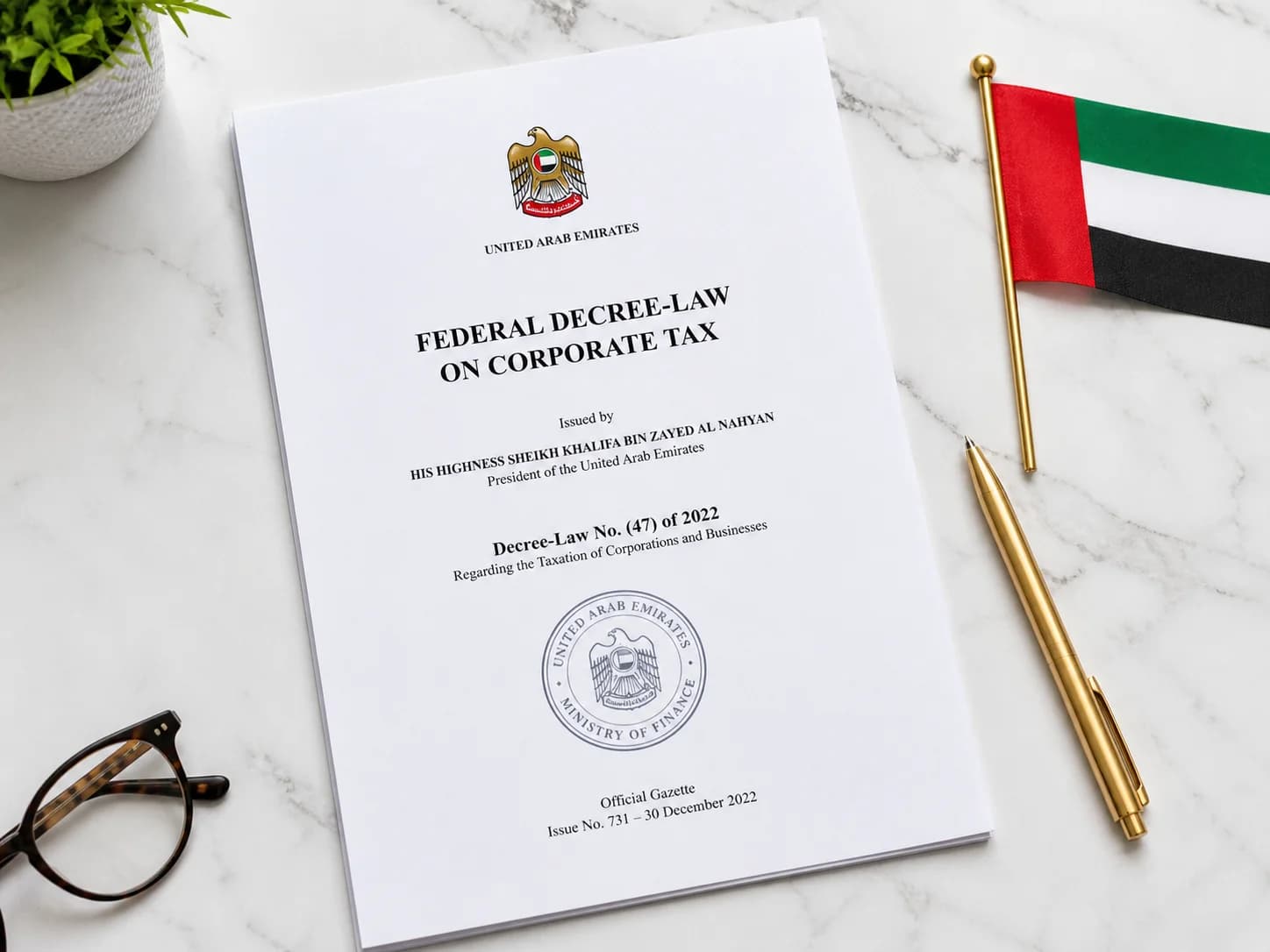
Federal Decree-Law No. 47 of 2022
Primary CT legislation. Establishes the 9% rate, AED 375,000 threshold, taxable persons, exempt persons, participation exemption, anti-avoidance rule, and penalties framework.
Cabinet Decision No. 116 of 2022
Sets out the conditions and mechanics for Small Business Relief, including the AED 3 million revenue cap and the election procedure.
Ministerial Decision No. 73 of 2023
Defines QFZP criteria, specifies qualifying income categories, and establishes the de minimis thresholds for non-qualifying income.
FTA Public Clarification CT001
General guidance on UAE Corporate Tax application, including treatment of certain income types and scope of the tax base.
FTA Public Clarification CT002
Addresses the free zone CT regime, clarifying qualifying income determination and how QFZP rules interact with mainland trading activity.
OECD BEPS Framework
Basis for UAE transfer pricing rules. Related-party transactions must follow the arm's-length standard and documentation requirements aligned with OECD guidelines.
Qualifying Free Zone Person (QFZP) — What It Means for Your Tax Bill
Free zone incorporation does not equal tax exemption. This is the most consequential misunderstanding in UAE Corporate Tax, and it affects a large proportion of free zone businesses operating today.
To be treated as a QFZP — and eligible for the 0% rate on qualifying income — your business must meet all four of the following conditions simultaneously:
Maintain adequate economic substance in the UAE free zone
Your business must have real operations, sufficient employees, and appropriate assets within the free zone. A registered address and a trade licence number are not sufficient. The substance requirement reflects actual business activity, not administrative presence.
Derive qualifying income as defined in Cabinet Decision
Qualifying income includes transactions with other free zone persons and certain categories of international transactions. It does not include income earned from mainland UAE customers, certain passive income streams, or income from activities outside the qualifying categories.
Have not elected to be subject to standard 9% CT
A free zone entity can voluntarily elect to be treated as a standard taxable person, subject to 9% on all taxable income above AED 375,000. Once made, this election is binding for a minimum period. The trade-off is losing the 0% benefit on qualifying income.
Comply with transfer pricing rules for related-party transactions
QFZP status does not remove transfer pricing obligations. If your free zone entity has transactions with related parties — including mainland UAE group companies — those transactions must be priced at arm's length and documented accordingly.
The de minimis rule
If your non-qualifying income exceeds 5% of your total revenue or AED 5 million — whichever is lower — you lose QFZP status for that period entirely. Your entire income becomes subject to 9% CT, not just the non-qualifying portion.
The mainland trading problem
If you trade regularly with mainland UAE clients, that income does not constitute qualifying income. It is subject to 9% CT regardless of your free zone registration. For many free zone businesses, this is a material and unexpected liability.
Corporate Tax Filing Deadlines and Penalties
Registration deadline
For businesses existing before 1 March 2024: staggered deadline by trade licence month (FTA Decision No. 3 of 2024) — most now passed. For businesses incorporated on or after 1 March 2024: within 3 months of incorporation.
Annual CT return
Within 9 months of the end of your CT financial year. FY ending 31 Dec 2024 → return due 30 Sep 2025. No automatic extension.
Tax payment
Due at the time of filing. There is no separate payment deadline. Late payment penalty: 14% per annum (simple interest) under Cabinet Decision No. 129 of 2025, effective 14 April 2026.
Record retention
All accounting records supporting the CT return must be retained for a minimum of 7 years after the end of the relevant tax period.
Penalty schedule (actively enforced)
What Does Corporate Tax Advisory Cost in the UAE?

CT registration only
AED 1,500–3,000One-time. Includes structure review, free zone eligibility check, EmaraTax registration, and TRN issuance.
Annual CT return — simple structure
AED 5,000–12,000 / yrSingle entity, clean records, no related-party complexity. Return preparation, filing, and position review.
Annual CT return — QFZP or multi-entity
AED 12,000–25,000 / yrFree zone QFZP analysis, qualifying income assessment, and de minimis calculation.
Complex structure — transfer pricing
AED 25,000–50,000+ / yrRelated-party transactions, Master File or Local File preparation, group-level CT consolidation.
Quarterly monitoring retainer
AED 1,500–4,000 / qtrQuarterly income tracking, deduction reviews, Small Business Relief monitoring throughout the year.
Exact fees depend on your structure, entity count, related-party transactions, and the quality of your existing accounting records. Use the cost calculator for an initial estimate, or book a free consultation for a fixed-fee quote based on your actual situation.
Every UAE business needs a clear CT plan — not just a registration number. Book your free consultation and get a structured overview of your corporate tax obligations in one call.
Book Free Consultation